Developers: ARM NXP Nordic Semiconductor ST Micro Microsoft , BBC.
The laboratory experiment aims to explore the possibilities of using the BBC Micro:bit RPi platform as the central element for an educational system for developing computational thinking and the Tiny Machine Learning universe.
The platform architecture, specific software tools, and categories of sensors usable for ML operations are explored. Special attention is
given to resources for speech synthesis.
At the end of the laboratory you will have sufficient information to start developing educational applications with the BBC Micro:bit platform.
Software: Thonny 
1. Blink LED on BBC Micro:bit 2. Using magnetic sensor 3. Using acceleration sensor 4. Display with messaging 5. Messaging for sensors 
Developed in a collaboration between BBC, ARM, Microsoft, NXP, Nordic Semiconductor, Lancaster University, ... the BBC Micro:bit platform has 2 interconnected ARM processors for independent operations interfaced with sensors and communication elements in a miniaturized structure as follows: 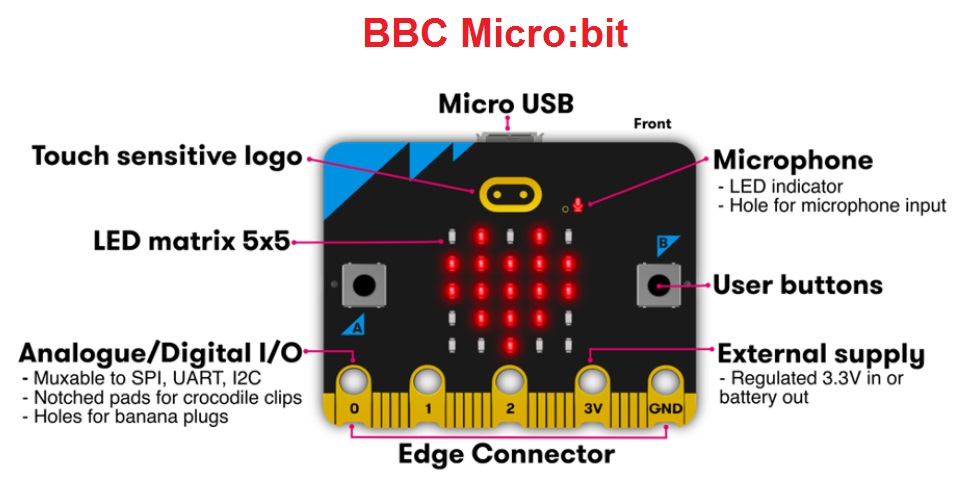 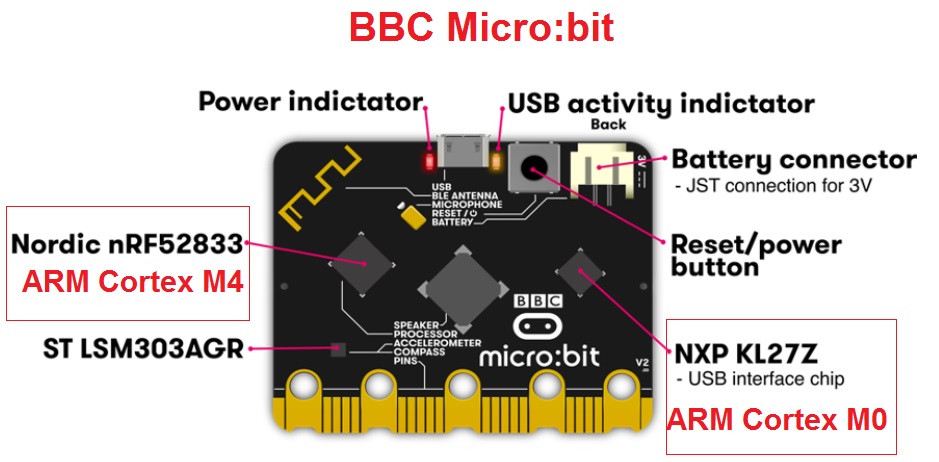

The signals from the execution processor are connected to an extension represented in the images below.  
 
1. Develop on BBC Micro:bit an application using the accelerometer sensor; 2. Develop on BBC Micro:bit an application using the microphone; 3. Develop on BBC Micro:bit an application using the magnetic sensor; 4. Develop on BBC Micro:bit an application using the light sensor; 
5. Develop on BBC Micro:bit a solution for data acquisition to be used in training solutions based on TinyML
- Building educational equipment for pupils/students ; - Creating peripherals for mobile phones; - Creating local networks of sensors/actuators; - Developing projects for Hackster.io  What did the graduates of this school create?
|


 © 2024 - Fl. Pantilimonescu, Faculty of Automatic Control and Computer Science