The laboratory experiment aims to explore the possibilities of using platformei Rpi Pico/W as the central element for building IoT systems interconnected via BT with mobile phones.
The project BBC Micro:bit > it can be extended with active elements built with the new generation of ARM Cortex M0+/M33 microcontrollers with extremely low energy consumption. The basic elements of the Rp2040/2350 microcontrollers are introduced, as well as the related programming resources. At the end of the laboratory, basic information will be available about how to develop microPython programs and run them on development platforms Raspberry Pi Pico/BBC Micro:bit.
Software: Aplicatie BT Terminal for Android phones ; Thonny 
1. Blink LED de pe Pico 2. Utilizare GPIO ca intrare 3. Generare intrerupere externa 4. Control extensie 3 LED-uri 5. Utilizare PWM pt. control intensitate LED 6. LED activation with mobile phone
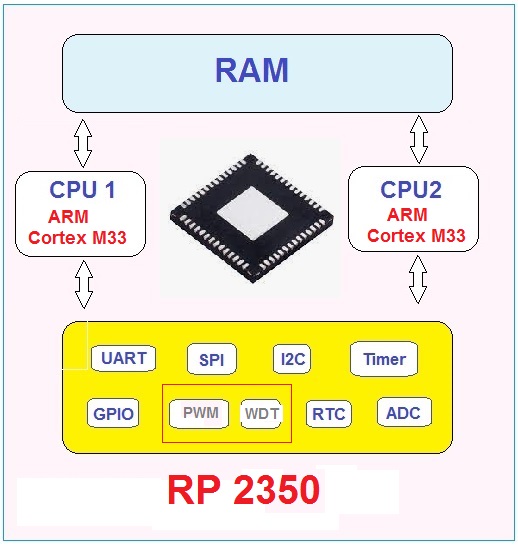
The RPi Pico development platforms have a processing structure based on 2 cores ARM Cortex M0+ care ii asigura cel mai bun nivel de eficienta energetica. To be programmable in Python they require loading a modul interpreter specific. Practically, with the button on the Pico pressed, it connects to the USB and is thus visible as a memory extension where files can be transferred interpretorul micropython. In Windows, the Application can be used Thonny for editing and transferring code to the Pico. In Linux there are similar resources introduced in Lab7.  

The example programs allow testing the MicroPython interpreter and accessing GPIO resources to which LED extensions can be attached, as shown in the diagram below: 
Going through the example programs as well as creating extensions of them requires exploring appropriate literature regarding micropython pentru Rpi Pico. 
1. Create an LED extension with galvanic isolation for optotriac control; 2. Create an extension with galvanic isolation for controlling 12V automotive relays; 3. Create a Python application that will allow precise determination of the execution time of a software sequence; 4. Determine the minimum frequency to eliminate the flickering phenomenon when adjusting the light intensity of an LED; 
5. Create a demonstrative sequence for powering the Pico platform with electrical energy from fruits/solar;
- Development of actuators for IoT; - Development of peripherals for mobile phones; - Development of local networks of sensors/actuators; - Development of applications for Embedded Linux. - Development of projects for Hackster.io - Development of applications in the TinyML universe 
|


 © 2025 Fl. Pantilimonecu - Faculty of Automatic Control and Computers